

Who Draws The Short Straw In The Canterbury Tales
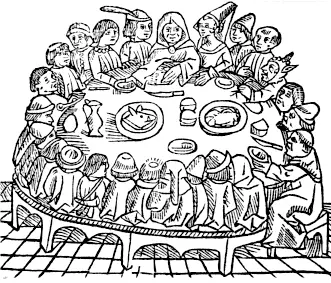
A woodcut from William Caxton'due south 2d edition of the Canterbury Tales printed in 1483.
The Canterbury Tales is a collection of stories written by Geoffrey Chaucer in the fourteenth century (2 of them in prose, the residuum in verse). The tales, some original and others not, are contained within a frame tale and told by a drove of pilgrims on a pilgrimage from Southwark to Canterbury to visit the shrine of Saint Thomas Becket at Canterbury Cathedral. The Canterbury Tales are written in Centre English language. Although the tales are considered to be his magnum opus, some believe the construction of the tales is indebted to the works of The Decameron, which Chaucer is said to have read on an earlier visit to Italy.
Contents
- 1 Synopsis
- 2 Dating issues
- 3 Text
- 4 Sources
- five Analysis
- 5.i Genre and structure
- five.2 Style
- 5.3 Historical context
- five.4 Themes
- 5.5 Influence
- 6 Reception
- 6.1 Chaucer's day
- 6.ii Fifteenth century
- seven The Pilgrims' Route and Real Locations
- viii Legacy
- 8.one Literary adaptations
- 9 Notes
- ten References and Further Reading
- xi External links
- 12 Credits
Chaucer is generally considered not only the father of English literature, but also, often of the English language language itself. His works, peculiarly The Canterbury Tales validated English language as a language capable of poetic greatness, and in the process instituted many of the traditions of English language poesy that take continued to this day. These works remain arguably the loftier point of literature written in Center English language, and demonstrate Chaucer'southward skill at realism, nuance, and label, which make them not only important historical documents, but timeless works of literature that tin still be enjoyed today.
Synopsis
On an April 24-hour interval, a group of medieval pilgrims prepare out on a pilgrimage from London to Canterbury to pay their respects to the tomb of Saint Thomas Becket at Canterbury Cathedral.[one] The group is described in detail, with characters from all classes, upper and lower, represented. Religious characters, including the monk and a pardoner, travel aslope a sailor, miller, carpenter, and a knight, among others. When the group stops for the night, the host of the pilgrimage proposes that they all tell stories to each other along the way. The pilgrims agree to tell four stories each, two on the mode to Canterbury, and two on the way dorsum. The person who tells the best story, equally determined past the host, will have his way paid by the residue of the grouping. The tale-telling begins with the knight and proceeds as the pilgrims well-nigh Canterbury, each person telling a story that reflects their social position, and some telling stories which are intended to make fun of others in the grouping. No winner is chosen by the host in the end, and only a few of the pilgrims take told their tales past the fourth dimension the story ends because Chaucer died before he could finish it. He originally intended to write 124 tales but only completed 24 before he died. Chaucer begins the work with an amends for anything in the stories which may be accounted inappropriate.
Dating problems
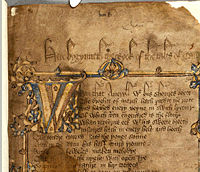
The opening folio of the Hengwrt manuscript contains the beginning of the Full general Prologue.
The appointment of the conception and writing of The Canterbury Tales as a drove of stories has proved difficult to ascertain. The Tales were begun subsequently some of Chaucer'due south other works, such as Legend of Good Women, which fails to mention them in a listing of other works by the writer. Nonetheless, it was probably written later his Troilus and Criseyde, since Legend is written in function as an apology for the portrayal of women in the Criseyde character. Troilus is dated to sometime betwixt 1382 and 1388, with Legend coming soon after, possibly in 1386-1387. Work on The Canterbury Tales as a whole probably began in the belatedly 1380s and continued as Chaucer neared his death in the yr 1400.[2] [3]
Two of the tales, The Knight'due south Tale and The Second Nun'due south Tale, were probably written before the compilation of stories was e'er conceived.[3] Both of these tales are mentioned in the Prologue to the same Legend of Good Women. [four] Other tales, such as the Clerk's and the Man of Law'south, are also believed to have been written earlier and later on added into the Canterbury Tales framework, simply there is less scholarly consensus virtually this. [five] The Monk's Tale is one of the few tales which depict an event which provides a clear date. It describes the death of Barnabo Visconti, which occurred on Dec 19, 1385, although some scholars believe the lines near him were added later on the primary tale had already been written.[6] The Shipman's Tale is believed to take been written before The Married woman of Bath's Tale; in parts of the tale the Shipman speaks every bit if he were a woman, leading scholars to believe that the Shipman's Tale was originally intended for the Married woman of Bathroom, earlier she became a more prominent character. References to her in Envoy to Bukton (1396) seem to bespeak that her character was quite famous in London by that time.[7]
Chaucer's use of sources also provide chronological clues. The Pardoner's Tale, the Wife of Bath'south Prologue, and the Franklin's Tale all draw frequent reference to Saint Jerome's Epistola adversus Jovinianum. Jerome'southward work is also an add-on to Chaucer's Prologue to a revised Legend of Adept Women dated to 1394, suggesting that these three tales were written sometime in the mid-1390s. Scholars have also used Chaucer's references to astronomy to find the dates specific tales were written. From the data Chaucer provides in the prologue, for example, the pilgrimage in which the tales are told takes place in 1387.[three] Still, this assumes that the astronomical evidence is reliable and Chaucer did non alter them for artistic effect.[eight]
Text
A total of 83 medieval manuscripts of The Canterbury Tales are known to exist, more whatsoever other vernacular medieval literary work except The Prick of Censor. This provides some prove for the tales' popularity during the fifteenth century.[9] Fifty-5 of these manuscripts are idea to take once been complete, while 28 more are so fragmentary that it is difficult to tell whether they were copied individually or were role of a larger prepare.[x] The Tales vary in both small and major ways from manuscript to manuscript, with many of the minor variations obviously coming from copyists' errors. However, other variations suggest that Chaucer himself was constantly adding to and revising his work as it was copied and distributed. No official, consummate version of the Tales exists and it is incommunicable with the data available to decide Chaucer's preferred club or fifty-fifty, in some cases, whether he even had any particular order in heed.[11] [12]
Scholars usually divide the tales into ten fragments. The tales that make up a fragment are directly connected and make clear distinctions about what order they go in, usually with one character speaking to and and then stepping bated for another character. Betwixt fragments, withal, there is less of a connexion. This means that there are several possible permutations for the order of the fragments and consequently the tales themselves. Below is list of the nearly popular ordering of the fragments:[11]
| Fragment | Tales |
|---|---|
| Fragment I(A) | General Prologue, Knight, Miller, Reeve, Melt |
| Fragment Ii(B1) | Man of Police |
| Fragment Three(D) | Wife, Friar, Summoner |
| Fragment Four(E) | Clerk, Merchant |
| Fragment V(F) | Squire, Franklin |
| Fragment Vi(C) | Physician, Pardoner |
| Fragment VII(B2) | Shipman, Prioress, Sir Thopas, Melibee, Monk, Nun's Priest |
| Fragment Eight(Thousand) | Second Nun, Catechism's Yeoman |
| Fragment IX(H) | Manciple |
| Fragment X(I) | Parson |
An alternative to this order is the placing of Fragment Eight(Yard) before VI(C). In other cases, the above order follows that set past early manuscripts. Fragments I and 2 nearly always follow each other, as exercise Half dozen and VII, IX and X in the oldest manuscripts. Fragments IV and V, by contrast are located in varying locations from manuscript to manuscript. Victorians would frequently motion Fragment VII(B2) to follow Fragment II(B1), simply this trend is no longer followed and has no justification.[xi] Fifty-fifty the earliest surviving manuscripts are not Chaucer's originals; the oldest is MS Peniarth 392 D (called "Hengwrt"), compiled by a scribe presently subsequently Chaucer'southward expiry. The scribe uses the order shown in a higher place, though he does not seem to have had a total collection of Chaucer's tales, then office are missing. The most beautiful of the manuscripts is the Ellesmere manuscript, and many editors have followed the social club of the Ellesmere over the centuries, even downward to the nowadays mean solar day.[13] [14] The latest of the manuscripts is William Caxton's 1478 print edition, the kickoff version of the tales to exist published in impress. Since this version was created from a now-lost manuscript, information technology is counted as amongst the 83 manuscripts.[15]
Sources
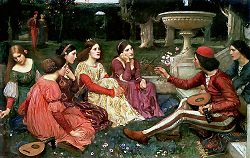
A Tale from the Decameron by John William Waterhouse.
Chaucer's narrative framework appears to have been original. No other work prior to Chaucer's is known to have set a drove of tales inside the framework of pilgrims on a pilgrimage. However, Chaucer borrowed portions, sometimes very big portions, of his stories from earlier stories, besides every bit from the general state of the literary world in which he lived. Storytelling was the main form of entertainment in England at the fourth dimension, and storytelling contests had been effectually for thousands of years. In fourteenth-century England the English Pui was a grouping with an appointed leader who would judge the songs of the group. The winner received a crown and, as with the winner of the Canterbury Tales, a free dinner. It was common for pilgrims on a pilgrimage to accept a called "master of ceremonies" to guide them and organize the journey.[16]
In that location are too numerous parallels with Boccaccio'southward Decameron. Similar the Tales, it features a number of narrators who tell stories along a journeying they have undertaken (to flee from the Blackness Plague). Information technology ends with an amends by Boccaccio, much like Chaucer'due south Retraction to the Tales. 1-fourth of the tales in Canterbury Tales parallels a tale in the Decameron, although most of them have closer parallels in other stories. Scholars thus notice it unlikely that Chaucer had a re-create of the piece of work on hand, surmising instead that he must have merely read the Decameron while visiting Italy at some bespeak.[17] Each of the tales has its own set of sources, just a few sources are used frequently over several tales, including the verse of Ovid, the Bible in 1 of its many vulgate versions available at the fourth dimension, and the works of Petrarch and Dante. Chaucer was the showtime author to utilize the work of these last two, both Italians. Boethius' Consolation of Philosophy appears in several tales, as do the works of John Gower, a known friend to Chaucer. Chaucer also seems to have borrowed from numerous religious encyclopedias and liturgical writings, such as John Bromyard's Summa praedicantium, a preacher's handbook, and St. Jerome'due south Adversus Jovinianum. [18]
Analysis
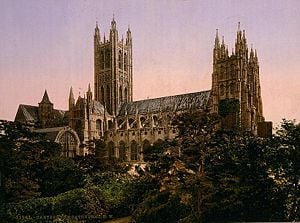
Canterbury Cathedral. View from the north westward circa 1890-1900 (retouched from a black & white photograph).
Genre and structure
The Canterbury Tales falls into the same genre as many other works of its day–a drove of stories organized into a frame narrative or frame tale. Chaucer'southward Tales differed from other stories in this genre chiefly in its intense variation. About story collections focused on a theme, usually a religious i. Fifty-fifty in the Decameron, storytellers are encouraged to stick to the theme decided on for the day. Chaucer's piece of work has much more than variation, non only in theme, but in the social class of the tellers and the meter and way of each story told than any other story of the frame narrative genre. The pilgrimage motif, which served equally a useful narrative device to accrue a various set of voices, was also unprecedented. Introducing a competition among the tales encourages the reader to compare the tales in all their diverseness, and allows Chaucer to showcase the breadth of his skill in dissimilar genres and literary forms.[19]
While the construction of the Tales is largely linear, with one story following another, it is too innovative in several respects. In the Full general Prologue, Chaucer describes not the tales just the narrators, making it clear that structure volition depend on the characters rather than a general theme or moral. This idea is reinforced when the Miller interrupts to tell his tale later the Knight has finished his. The Knight goes offset, suggesting that the order of narrators will be determined by form, only the Miller's interruption makes information technology clear that this structure volition be abandoned in favor of a complimentary and open exchange of stories amongst all classes present. Chaucer develops several general themes and points of view past having some narrators respond to themes addressed by previous narrators, sometimes later a long lapse in which the theme has not been addressed.[20]
Chaucer does not take involvement in the progress of the trip, the passage of time, or specific locations every bit the pilgrim travel to Canterbury. His focus is on the tales themselves, and non on the pilgrimage.[21]
Style
The variety of Chaucer's tales shows the breadth of his skill and his familiarity with endless rhetorical forms and linguistic styles. [22]
Medieval schools of rhetoric at the time encouraged such diversity, dividing literature (as Virgil suggests) into loftier, eye, and low styles as measured by the density of rhetorical forms and vocabulary. Another popular method of segmentation came from St. Augustine, who focused more on audition response and less on subject field matter (a Virgilian concern). Augustine divided literature into "majestic persuades," "temperate pleases," and "subdued teaches." Writers were encouraged to write in a way that kept in mind the speaker, subject area, audience, purpose, style, and occasion. Chaucer moves freely between all of these styles, showing favoritism to none. He not only considers the readers of his work as an audience, but the other pilgrims within the story as well, creating a multi-layered rhetorical puzzle of ambiguities. Chaucer's work thus far surpasses the ability of whatsoever single medieval theory to uncover.[23]
With this Chaucer avoids targeting whatsoever specific audience or social course of readers, focusing instead on the characters of the story and writing their tales with a skill proportional to their social status and learning. However, fifty-fifty the lowest characters, such as the Miller, show surprising rhetorical ability, although their subject matter is more lowbrow. Vocabulary also plays an important part, equally those of the college classes refer to a woman every bit a "lady," while the lower classes utilize the word "wenche," with no exceptions. At times the same word will mean entirely dissimilar things betwixt classes. The word "pitee," for example, is a noble concept to the upper classes, while in the Merchant'south Tale it refers to sexual intercourse. Once again, notwithstanding, tales such as the Nun's Priest'due south Tale show surprising skill with words among the lower classes of the group, while the Knight's Tale is at times extremely simple.[24]
Chaucer uses the same meter throughout almost all of his tales, with the exception of Sir Thopas and his prose tales. It is a decasyllable line, probably borrowed from French and Italian forms, with riding rhyme and, occasionally, a caesura in the eye of a line. His meter would later develop into the heroic meter of the fifteenth and sixteenth centuries and is an ancestor of iambic pentameter. He avoids allowing couplets to become too prominent in the poem, and iv of the tales (the Human being of Law's, Clerk's, Prioress', and 2nd Nun's) use rhyme majestic.[25]
Historical context
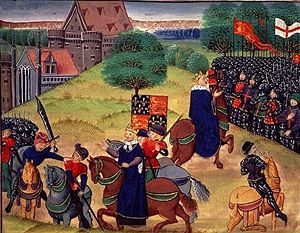
The Peasant's Revolt of 1381 is mentioned in the Tales.
The time of the writing of The Canterbury Tales was a turbulent time in English history. The Catholic Church was in the midst of the Smashing Schism and, though information technology was still the but Christian authorisation in Europe, information technology was the subject of heavy controversy. Lollardy, an early on English religious movement led by John Wycliffe, is mentioned in the Tales, as is a specific incident involving pardoners (who gathered money in exchange for absolution from sin) who nefariously claimed to be collecting for St. Mary Rouncesval hospital in England. The Canterbury Tales is among the kickoff English literary works to mention paper, a relatively new invention which allowed dissemination of the written word never before seen in England. Political clashes, such as the 1381 Peasant's Revolt and clashes ending in the degradation of King Richard 2, further reveal the complex turmoil surrounding Chaucer in the time of the Tales' writing. Many of his close friends were executed and he himself was forced to movement to Kent in gild to get away from events in London.[26] The Canterbury Tales can besides tell modern readers much near "the occult" during Chaucer's time, particularly in regards to astrology and the astrological lore prevalent during Chaucer'south era. There are hundreds if not thousands of astrological allusions establish in this work; some are quite overt while others are more subtle in nature.
In 2004, Professor Linne Mooney was able to identify the scrivener who worked for Chaucer as an Adam Pinkhurst. Mooney, then a professor at the University of Maine and a visiting boyfriend at Corpus Christi College, Cambridge, was able to match Pinkhurst's signature, on an oath he signed, to his lettering on a copy of The Canterbury Tales that was transcribed from Chaucer'due south working copy. While some readers look to interpret the characters of "The Canterbury Tales" every bit historical figures, other readers choose to interpret its significance in less literal terms. After analysis of his wording and historical context, his work appears to develop a critique against society during his lifetime. Within a number of his descriptions, his comments tin can appear complimentary in nature, only through clever language, the statements are ultimately disquisitional of the pilgrim'south actions. Information technology is unclear whether Chaucer would intend for the reader to link his characters with actual persons. Instead, it appears that Chaucer creates fictional characters to exist full general representations of people in such fields of work. With an understanding of medieval guild, one can detect subtle satire at work. The theme of marriage mutual in the tales has been presumed to refer to several different marriages, most ofttimes those of John of Gaunt. Chaucer himself was i of the characters on the pilgrimage, and some other character, Harry Bailly of the Tabard Inn, was a real person likewise. It is considered quite likely the cook was Roger Knight de Ware, a contemporary London cook.
Themes
The themes of the tales vary, and include topics such equally ladylike love, treachery, and forehandedness. The genres also vary, and include romance, Breton lai, sermon, brute fable, and fabliaux. Though there is an overall frame, there is no single poetic construction to the work; Chaucer utilizes a variety of rhyme schemes and metrical patterns, and there are as well two prose tales.
Some of the tales are serious and others comical. Religious malpractice is a major theme, every bit is the segmentation of the three estates. Well-nigh of the tales are interlinked past common themes, and some "quit" (answer to or retaliate for) other tales. The work is incomplete, every bit information technology was originally intended that each character would tell 4 tales, two on the style to Canterbury and two on the return journey, for a total of one hundred twenty, which would accept dwarfed the 24 tales actually written.
The Canterbury Tales includes an account of Jews murdering a deeply pious and innocent Christian boy ('The Prioress's Tale'). This blood libel against Jews became a role of English literary tradition.[27] However, the story the Prioress tells did not originate in the works of Chaucer: it was well known in the fourteenth century.[28]
Influence
It is sometimes argued that the greatest contribution that this work fabricated to English literature was in popularizing the literary employ of the vernacular, English language, rather than French or Latin. English had, however, been used as a literary language for centuries before Chaucer's life, and several of Chaucer's contemporaries—John Gower, William Langland, and the Pearl Poet—likewise wrote major literary works in English. It is unclear to what extent Chaucer was responsible for starting a trend rather than but being part of it. It is interesting to note that, although Chaucer had a powerful influence in poetic and artistic terms, which can be seen in the great number of forgeries and mistaken attributions (such as The Flower and the Leafage which was translated by John Dryden), modern English spelling and orthography owes much more to the innovations made past the Court of Chancery in the decades during and after his lifetime.
Reception
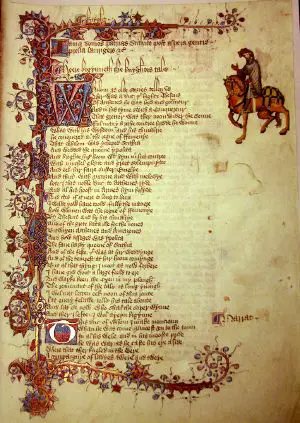
The beginning of The Knight'due south Tale from the Ellesmere manuscript.
Chaucer'due south day
The intended audience of The Canterbury Tales has proved very hard to make up one's mind. In that location are no external clues other than that Chaucer was a courtier, leading some to believe that he was a courtroom poet and wrote mostly for the dignity. However, none of his associates mention the fact that he was a poet in any known historical certificate. Scholars take suggested that the verse form was intended to exist read aloud, which is probable, as that was a common activeness at the time when literacy was express. However, it also seems to accept been intended for private reading as well, since Chaucer ofttimes refers to himself as the author, rather than the speaker, of the work. Determining the intended audience direct from the text is even more difficult, since the audience is role of the story. This makes information technology difficult to tell when Chaucer is writing to the fictional pilgrim audition or the bodily reader.[29]
Chaucer'south works were distributed in some form while he was alive, probably in fragmented pieces or equally individual tales. Scholars speculate that manuscripts were circulated among his friends, but likely remained unknown to nigh people until subsequently his death. Nevertheless, the speed with which copyists strove to write complete versions of his tale in manuscript form shows that Chaucer was a famous and respected poet in his own day. The Hengwrt and Ellesmere manuscripts are examples of the care taken to distribute the work. More manuscript copies of the poem be than for any other poem of its twenty-four hour period except Ayenbite of Inwyt, The Prick of Conscience, a translation of a French language volume of moral tales, causing some scholars to give it the medieval equivalent of "best-seller" condition. Even the well-nigh elegant of the illustrated manuscripts, however, is not about every bit decorated and fancified as the work of authors of more respectable works such as John Lydgate's religious and historical literature.[xxx]
Fifteenth century
John Lydgate and Thomas Occleve were among the first critics of Chaucer'southward Tales, praising the poet equally the greatest English poet of all time and the kickoff to truly show what the language was capable of poetically. This sentiment is universally agreed upon by later critics into the mid-fifteenth century. Glosses included in Canterbury Tales manuscripts of the time praised him highly for his skill with "sentence" and rhetoric, the 2 pillars past which medieval critics judged poesy. The nearly respected of the tales was at this time the Knight'south, equally it was full of both.[31]
The Pilgrims' Route and Real Locations
The Metropolis of Canterbury has a museum dedicated to The Canterbury Tales. [32]
The postulated return journey has intrigued many and continuations have been written also, often to the horror or (occasional) delight of Chaucerians everywhere, as tales written for the characters who are mentioned just not given a take chances to speak. The Tale of Beryn [33] is a story past an anonymous author inside a fifteenth century manuscript of the piece of work. The tales are rearranged and there are some interludes in Canterbury, which they had finally reached, and Beryn is the commencement tale on the return journey, told by the Merchant. John Lydgate's Siege of Thebes is likewise a delineation of the return journey but the tales themselves are actually prequels to the tale of classical origin told by the Knight in Chaucer'due south work.
Legacy
The Canterbury Tales is one of the most important works of the Western literary catechism. It is read by near all students of English literature and often imitated and adapted, making it accessible to a wider range of audiences.
Literary adaptations
The title of the piece of work has become an everyday phrase and been variously adapted and adopted; for example Margaret Atwood's The Handmaid'south Tale, among many others.
Many literary works (both fiction and non-fiction alike) have used a like frame narrative to the Canterbury Tales in homage to Geoffrey Chaucer's piece of work. Science Fiction writer Dan Simmons wrote his Hugo Award winning novel Hyperion based around an extra-planetary grouping of pilgrims. Evolutionary biologist Richard Dawkins used The Canterbury Tales every bit a structure for his 2004 non-fiction book about evolution–The Ancestor'southward Tale: A Pilgrimage to the Dawn of Evolution. His brute pilgrims are on their manner to observe the common ancestor, each telling a tale most evolution. The Yeoman is besides known as "Pogue… I'm a G!!"
Henry Dudeney (1857–1930) was an English mathematician whose book The Canterbury Puzzles contains a office which is supposedly lost text from The Canterbury Tales.
Historical mystery novelist P.C. Doherty wrote a series of novels based on The Canterbury Tales, making use of the story frame and of Chaucer's characters.
Notes
- ↑ The shrine was destroyed in the sixteenth century during the dissolution of the monasteries.
- ↑ Derek Pearsall. The Canterbury Tales. (London: G. Allen & Unwin, 1985), 1
- ↑ three.0 3.1 3.two Helen Cooper. The Canterbury Tales. (Oxford Oxfordshire: Oxford Academy Press, 1996), 5
- ↑ Pearsall, two
- ↑ Pearsall, 4
- ↑ Pearsall, 5
- ↑ Pearsall, 5—half-dozen
- ↑ Pearsall, seven
- ↑ Pearsall, 8
- ↑ Cooper, 6—7
- ↑ 11.0 11.i 11.two Cooper, 7
- ↑ Pearsall, fourteen-15
- ↑ Pearsall, 10, 17
- ↑ Cooper, 8
- ↑ Pearsall, 8
- ↑ Cooper, ten
- ↑ Cooper, ten-11
- ↑ Cooper, 12-16
- ↑ Cooper, eight-9
- ↑ Cooper, 17-18
- ↑ Cooper, 18
- ↑ "Diversity seems to exist the organizing principle of the collection. The Canterbury Tales includes an extraordinarily wide range of material in poesy (in rhymed decasyllable couplets, rhymed imperial poetry) and prose, roofing a wide range of literary genres and forms; romances, fabliaux, an fauna fable, saints' lives, exemplary narratives, a moral treatise, a prose treatise on the procedure of penitence (which concludes the game)." The Bloomsbury Guide to English Literature, Wynne-Davies, Marion, ed., (Bloombury Publishing Limited, 1990, ISBN 0136896626), 383
- ↑ Cooper, 22-24
- ↑ Cooper, 24-25
- ↑ Cooper, 25-26
- ↑ Cooper, 5-6
- ↑ Alexis P. Rubin, (ed.) Scattered Among the Nations: Documents Affecting Jewish History. 49 to 1975. (Toronto: Wall & Emerson, 1993), 106—107
- ↑ Jane Zatta, "The Prioress's Tale". Retrieved Nov eighteen, 2008.
- ↑ Pearsall, 294-295
- ↑ Pearsall, 295-297
- ↑ Pearsall, 298-302
- ↑ Canterbury Tales Museum, Canterbury. Retrieved November xviii, 2008.
- ↑ The Canterbury Interlude and Merchant'south Tale of Beryn, Edited by John M. Bowers. Originally Published in The Canterbury Tales: Fifteenth-Century Continuations and Additions. (Kalamazoo, MI: Medieval Institute Publications, 1992. ISBN 1879288230) The Canterbury Interlude and Merchant's Tale of Beryn .University of Rochester Library. Retrieved December 1, 2008.
References and Further Reading
- The Bloomsbury Guide to English Literature, Wynne-Davies, Marion, ed., Bloombury Publishing Limited, 1990, ISBN 0136896626.
- The Canterbury Interlude and Merchant's Tale of Beryn, Edited by John M. Bowers. Originally Published in The Canterbury Tales: Fifteenth-Century Continuations and Additions. Kalamazoo, MI: Medieval Institute Publications, 1992. ISBN 1879288230.
- Collette, Carolyn. Species, Phantasms and Images: Vision and Medieval Psychology in the Canterbury Tales. Ann Arbor: University of Michigan Printing, 2001. ISBN 9780472111619
- Cooper, Helen. The Canterbury Tales. Oxford Oxfordshire: Oxford Academy Press, 1996. ISBN 0198711557.
- Kolve, V.A. and Glending Olson, Eds. The Canterbury Tales: Fifteen Tales and The General Prologue; Administrative Text, Sources and Backgrounds, Criticism, second ed. (A Norton Critical Edition) New York; London: W.W. Norton and Visitor, 2005. ISBN 0393925870.
- Pearsall, Derek. The Canterbury Tales. London: Thou. Allen & Unwin, 1985. ISBN 0048000213
- Rubin, Alexis P., ed. Scattered Among the Nations: Documents Affecting Jewish History. 49 to 1975. Toronto: Wall & Emerson, 1993. ISBN 1895131103.
- Thompson, N.S. Chaucer, Boccaccio, and the Fence of Honey: A Comparative Report of the Decameron and the Canterbury Tales. Oxford: Oxford University Press, 1996. ISBN 0198123787.
External links
All links retrieved January 24, 2020.
- Audio prune from the kickoff function of the Miller'due south Tale
- Audio clip from the second role of the Miller'due south tale
- Audio prune from the prologue of the Canterbury Tales
- Sound clip from The Miller's Tale and The Second Nun'southward Tale
- The Canterbury Tales and Other Poems, available for gratis via Project Gutenberg
- "Modernistic English language translation of the Canterbury Tales"
- Originals from the British Library high resolution scans of William Caxton'due south two editions of Chaucer'south Canterbury Tales
- The Hengwrt Manuscript: high-resolution image of the first page of the oldest manuscript copy.
- Manuscript images, transcripts and collations from The Miller'south Tale and The Nun's Priest's Tale
| Geoffrey Chaucer | |
|---|---|
| The Canterbury Tales | |
| General Prologue • The Knight's Tale • The Miller's Tale • The Reeve'due south Tale • The Cook'south Tale • The Man of Law's Tale • The Married woman of Bathroom's Tale • The Friar's Tale • The Summoner's Tale • The Clerk'southward Tale • The Merchant'due south Tale • The Squire's Tale • The Franklin'southward Tale • The Dr.'s Tale • The Pardoner'southward Tale • The Shipman'south Tale • The Prioress'south Tale • Chaucer's Tale of Sir Topas • The Tale of Melibee • The Monk's Tale • The Nun'due south Priest's Tale • The Second Nun'southward Tale • The Canon'southward Yeoman's Tale • The Manciple'southward Tale • The Parson's Tale • Chaucer's Retraction | |
| Other works | |
| The Book of the Duchess • The House of Fame • Anelida and Arcite • The Parliament of Fowls • Boece • The Romaunt of the Rose • Troilus and Criseyde • The Legend of Good Women • Treatise on the Astrolabe | |
Credits
New Earth Encyclopedia writers and editors rewrote and completed the Wikipedia commodity in accordance with New World Encyclopedia standards. This commodity abides by terms of the Creative Commons CC-by-sa 3.0 License (CC-by-sa), which may exist used and disseminated with proper attribution. Credit is due under the terms of this license that tin reference both the New World Encyclopedia contributors and the selfless volunteer contributors of the Wikimedia Foundation. To cite this article click here for a list of acceptable citing formats.The history of earlier contributions by wikipedians is accessible to researchers here:
- The Canterbury Tales history
The history of this article since it was imported to New World Encyclopedia:
- History of "The Canterbury Tales"
Annotation: Some restrictions may apply to utilize of individual images which are separately licensed.

Source: https://www.newworldencyclopedia.org/entry/The_Canterbury_Tales
Posted by: carsonadvit1993.blogspot.com
0 Response to "Who Draws The Short Straw In The Canterbury Tales"
Post a Comment